•
•
•
•
•
•
1
•
•
2
•
•
3
•
•
4
•
•
5
•
•
6
•
•
7
•
•
8
•
•
9
•
•
10
•
•
11
•
•
12
•
•
13
•
•
14
•
•
15
•
•
16
•
•
17
•
•
18
•
•
19
•
•
20
•
•
21
•
•
22
•
•
23
•
•
24
•
•
25
•
•
•
•
•
•
•
•
•
•
1
•
•
2
•
•
3
•
•
4
•
•
5
•
•
6
•
•
7
•
•
8
•
•
9
•
•
10
•
•
11
•
•
12
•
•
13
•
•
14
•
•
15
•
•
16
•
•
•
•
Layoffs and the Mental Health of LGBTQIA+ Tech Workers
This research explores the unique challenges faced by LGBTQIA+ tech workers during layoffs. The study aims to empower LGBTQIA+ tech workers to navigate layoffs with greater resilience and contribute their talents to a more inclusive and just tech industry.
Year
2024
Client
Out in Tech
Role
UX Researcher
Tools
Google, Trello, Miro
Year
2024
Client
Out in Tech
Role
UX Researcher
Tools
Google, Trello, Miro

Overview
How can Out In Tech (OIT) help LGBTQIA+ tech workers facing layoffs?
While layoffs disproportionately affect LGBTQIA+ tech workers, the full scope of their emotional and professional impact remains poorly understood. These workers often face distinct challenges, including heightened anxiety about job security tied to their identities and the struggle to rebuild careers in an uncertain environment.
Background
This study aims to investigate how LGBTQIA+ tech workers navigate the interconnected challenges of mental health, resilience-building, and career transitions during layoffs. Layoffs, by their nature, increase feelings of vulnerability and uncertainty, and for queer individuals, these challenges are amplified by the need for support systems that acknowledge and affirm their identities.
Problem
LGBTQIA+ tech workers often face fear, anxiety, and uncertainty during layoffs, exacerbated by a lack of tailored mental health resources and career transition support. This absence of dedicated assistance hinders their ability to navigate job loss and regain stability in a competitive job market. It's crucial to advocate for more comprehensive support systems that address their unique needs during these crucial transitions.
Solution
To support LGBTQIA+ workers during layoffs, organizations like OIT can implement programs that address emotional challenges. These programs can include support groups for individuals exploring their identities and partnerships with queer-aligned organizations to offer activities that promote emotional stability during career transitions.
Time Line
What were the key factors that influenced time for this project?
Our 25-week project, "The Impact of Layoffs on LGBTQ+ Mental Health," followed a clear process. We defined our goals, chose methods, gathered data, and analyzed findings to compile a report with key insights and recommendations.

Discovery (Weeks 1-3):
Defined research goals
Presented pitch and brief to stakeholders
Secured project approval
Planning (Weeks 4-8):
Established research methods
Determined recruitment criteria
Completed recruitment preparations
Finalized interview discussion guide
Fielding (Weeks 9-16):
Distributed recruitment post and screener survey
Selected participants
Conducted interviews
Retrieved data from OIT Slack channels
Analysis (Weeks 17-22):
Defined explicit coding requirements
Completed qualitative coding analysis
Completed affinity mapping
Identified key insights
Reporting (Weeks 23-25):
Drafted final report
Drafted executive summary
Prepared recommendations and slide deck for final showcase
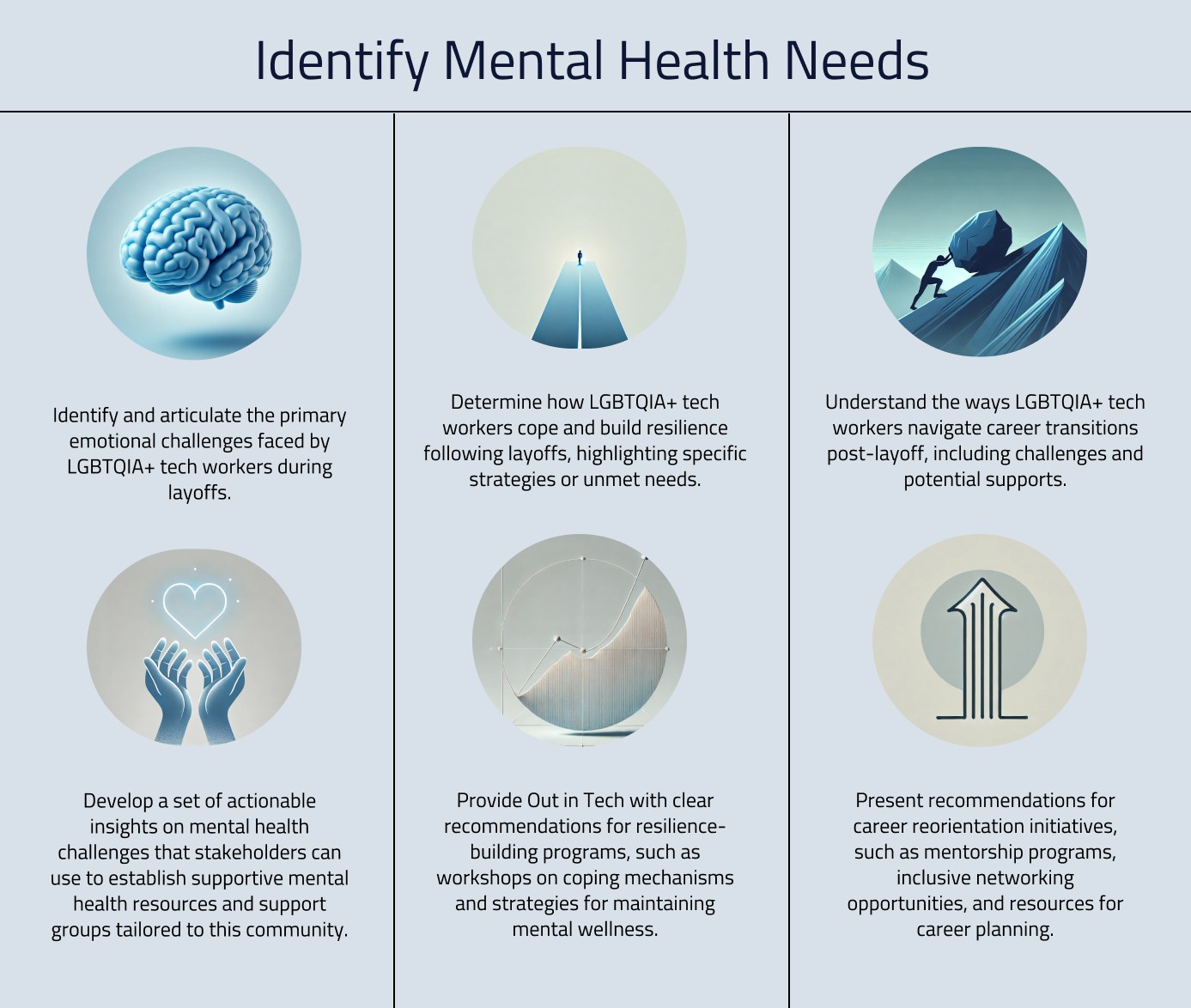
Research Objective
How do LGBTQIA+ individuals in the tech industry navigate transitions during layoffs?
Mental Health Experience
Considering the key factors and emotions involved, how do LGBTQIA+ tech workers articulate their emotional experiences following layoffs? This focuses on directly expressed emotions, without inferring or implying feelings.
Resilience Building
How do LGBTQIA+ tech workers address and manage their emotions and build (or tap into) resilience following layoffs? This examines coping mechanisms, positive self-talk, concrete actions, and how LGBTQIA+ identity plays a role in resilience.
Career Reorientation
In what ways do LGBTQIA+ tech workers reorient their career paths post-layoff, leveraging community resources and professional networks while prioritizing their mental well-being? This delves into the concrete actions taken during career transitions, including networking, professional development, and prioritizing mental health.
Success Criteria
The success of this project is measured by its ability to answer the following key research questions and provide actionable insights:
Research Methods
The study uses a qualitative methodology to understand the efforts of these individuals.
Participants
The study involved 30-minute in-depth interviews with LGBTQIA+ tech workers who self-identified as queer and had experienced layoffs during the specified timeframe. Participants were recruited using a screener form (Appendix A) to ensure alignment with the study's goals and participant diversity.
Data Collection
In-depth interviews (IDIs) were conducted virtually via Zoom. All participants provided informed consent (Appendix B) and were guided by a structured discussion guide (Appendix C). After the interviews, participants were provided with resources (Appendix D) to support their mental well-being.
Data Analysis
Qualitative coding was used to analyze the interview transcripts (Appendix E). Codes were developed to capture emotional experiences, coping strategies and resilience, and career reorientation actions.
Emotional Experiences
Focused on identifying direct statements related to mental health and emotional articulation.
Coping Strategies
Analyzed participants' strategies for dealing with emotional challenges and building resilience. This included evidence of emotional processing, positive self-talk, concrete actions, and the connection between LGBTQIA+ identity and resilience strategies.
Thematic Development
Affinity mapping in Miro was used to translate individual coded pieces of transcript into themes. Iterative comparison of codes within each grouping allowed for the definition of themes related to each research question.

Recruitment Criteria & Process
How did their individual experiences with job loss in the tech industry shape our understanding of this phenomenon?
We aimed to understand the various experiences of individuals facing job loss in the tech industry. Participants' diverse perspectives were essential to our research, revealing the challenges they encountered and the strategies they used. We prioritized creating a comfortable environment for sharing, as their honesty was crucial for grasping the human impact of job loss in this sector.
Who We're Looking For:
LGBTQIA+ Identity: We are looking for individuals who identify as part of the LGBTQIA+ community.
Tech Industry Experience: Participants must have worked in the tech industry within the past two years.
Layoff Experience: We are primarily interested in individuals who have been laid off from a tech job since January 2023. We will also consider those laid off before January 2023, but they will not be prioritized.
Age: Participants must be 18 years old or older by June 1st, 2024.
How We'll Find Them:
Initial Screening: We'll use a simple online form to collect basic information and confirm eligibility. This includes name, email, identity, tech experience, current employment status, layoff experience, and age. The form also includes questions about sexual orientation, race/ethnicity, and other demographic information.
Eligibility Review: The research team will review submitted forms and contact those who meet the criteria.
Informed Consent: Eligible participants will receive an email explaining the study's purpose and procedures. They will also have the option to opt-in to a raffle for a $10 Visa gift card.
Interview Scheduling: Participants who consent will schedule a one-on-one video interview online.
Key Findings
The diverse demographics of participants, spanning various ethnic, racial, gender identity, and sexual orientation spectrums, provide a nuanced understanding of the varied experiences within the LGBTQIA+ community.
Emotional Impact
For our first research question, we wanted to understand how queer individuals articulate their emotional experiences. After being laid off, LGBTQ+ individuals describe their emotional state as encircling feelings of depression, being overwhelmed, experiencing heartbreak, feeling devastated, and a general sense of unhappiness.
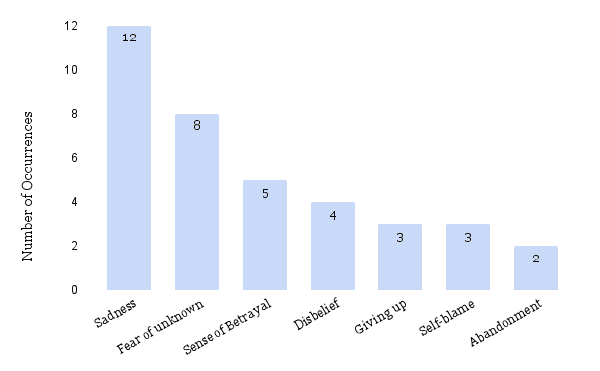
One of the research participants stated: "When I knew that I was kind of on the chopping block, I had a good cry."
It encompasses a profound sense of mourning for their professional identity, which is often deeply intertwined with their sense of self and worth. This loss can be particularly acute for individuals who find belonging and validation in their workplace community.
Networking
A common theme we found was that networking is a signal that laid off workers are ready to start the next phase of their journey. Networking is defined as actions taken to establish and nurture professional and personal connections to offer support, create opportunities, and access resources.
One participant shared, "I signed up for some in-person classes here… but also to try to network my way within the tech community here as well." This practice of networking serves as a means of mutual support during a period of job displacement. Participants find it valuable to engage with other people who are navigating a layoff, or those who hold positions in the tech industry, while reorienting their career paths.
Self Beyond Work
This concept, "defining the self beyond work," emerged from our interviews and refers to the resilience developed by separating one's self-worth from one's career and cultivating aspects of one's identity outside one's professional role. Engaging in enjoyable activities to maintain mental well-being during the job search.
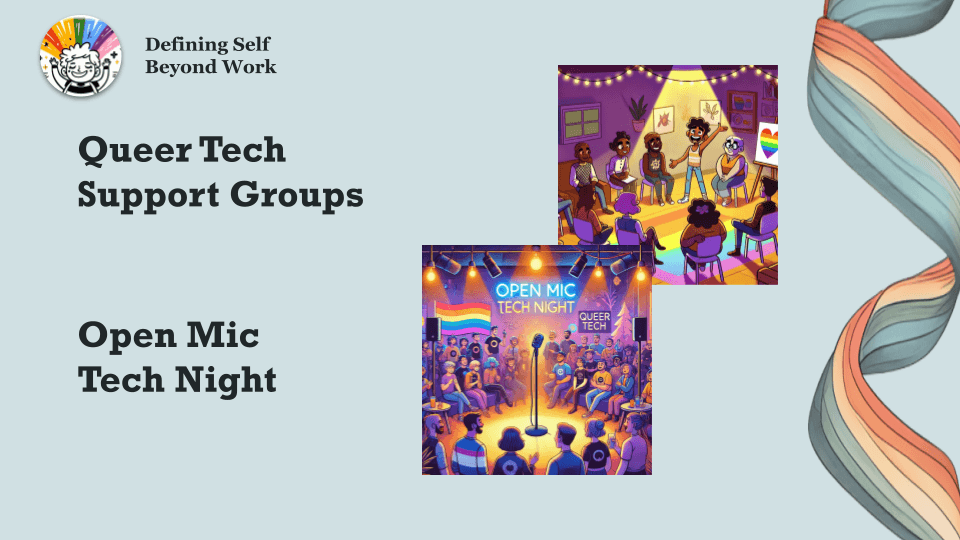
Participant #5 expressed this sentiment: "I realized my identity is bigger than my job. I have other, more important parts of myself."
This theme resonated strongly throughout our interviews, appearing six times, making it the second most prevalent theme for this research question. Examples of this theme in action include LGBTQ+ individuals prioritizing their health and well-being after layoffs, recognizing their worth goes beyond their job title, and seeking work that aligns with their personal values and passions.
Next steps &
recommendations
By taking these steps, OIT and other queer-serving organizations can create a more supportive and empowering environment for LGBTQIA+ tech workers facing layoffs, helping them navigate this challenging time with greater resilience and ultimately thrive in their careers. Our findings suggest that organizations like Out In Tech (OIT) have a crucial role to play in providing targeted support:
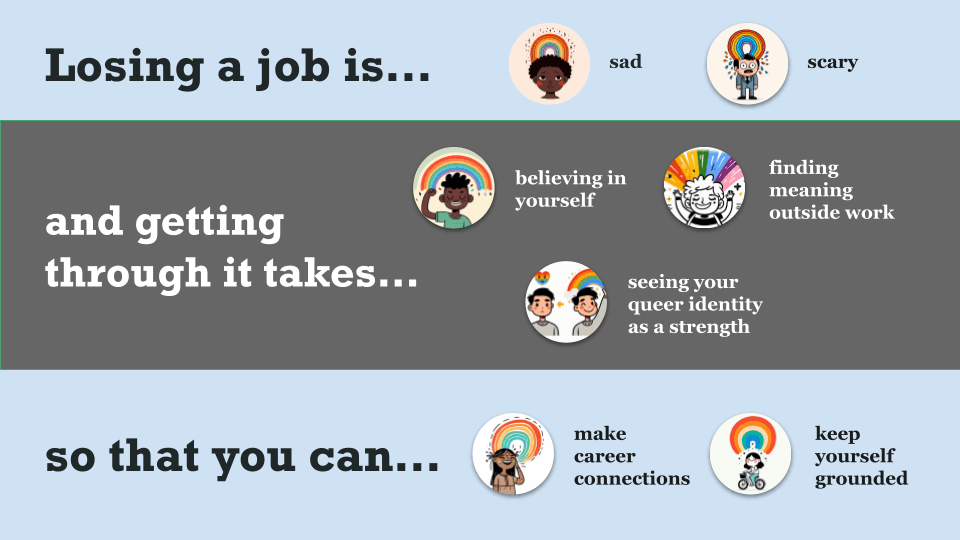
Addressing Emotional Challenges
Layoffs often trigger feelings of fear, anxiety, and uncertainty, particularly for those who already experience marginalization. OIT can offer programs that address these common negative emotions, providing concrete information and support for navigating the immediate aftermath of a layoff
Fostering Identity Exploration
Resilience during layoffs often involves redefining one's identity beyond their job. OIT can create spaces for LGBTQIA+ individuals to explore and affirm their identity outside of their professional roles, fostering a sense of belonging and self-worth that extends beyond their careers.
Strengthening Queer-Specific Networks
Connecting with others within the LGBTQIA+ community is vital for support and resources. OIT can promote and enhance queer-specific networking opportunities within the tech industry, providing access to unique job opportunities and career advice tailored to the community's needs.
Prioritizing Mental Health
Maintaining mental well-being is essential during job transitions. OIT can promote mental health awareness and resources, encouraging individuals to engage in grounding activities and self-care to manage stress and maintain a sense of balance.
Link to
Report
Reflections
By promoting mental health awareness and fostering inclusive environments, we can help LGBTQIA+ tech workers navigate layoffs and thrive in their careers.
Long-Term Impacts:
The study focused on the immediate aftermath of layoffs. Further research is needed to understand the long-term consequences of job loss on the mental health and career trajectories of LGBTQIA+ tech workers.
Beyond the Numbers
The qualitative analysis goes beyond demographic data, uncovering the lived experiences and emotional struggles of LGBTQIA+ individuals facing layoffs. This humanizes the impact of job loss and provides a deeper understanding of their needs.
The Power of Community
The findings emphasizes the vital role of queer-specific networks in providing support, resources, and a sense of belonging for LGBTQIA+ individuals during challenging times.
Layoffs and the Mental Health of LGBTQIA+ Tech Workers
This research explores the unique challenges faced by LGBTQIA+ tech workers during layoffs. The study aims to empower LGBTQIA+ tech workers to navigate layoffs with greater resilience and contribute their talents to a more inclusive and just tech industry.
Year
2024
Client
Out in Tech
Role
UX Researcher
Tools
Google, Trello, Miro
Google, Trello, Miro
Overview
Overview
How can Out In Tech (OIT) help LGBTQIA+ tech workers facing layoffs?
While layoffs disproportionately affect LGBTQIA+ tech workers, the full scope of their emotional and professional impact remains poorly understood. These workers often face distinct challenges, including heightened anxiety about job security tied to their identities and the struggle to rebuild careers in an uncertain environment.
Background
This study aims to investigate how LGBTQIA+ tech workers navigate the interconnected challenges of mental health, resilience-building, and career transitions during layoffs. Layoffs, by their nature, increase feelings of vulnerability and uncertainty, and for queer individuals, these challenges are amplified by the need for support systems that acknowledge and affirm their identities.
This study aims to investigate how LGBTQIA+ tech workers navigate the interconnected challenges of mental health, resilience-building, and career transitions during layoffs. Layoffs, by their nature, increase feelings of vulnerability and uncertainty, and for queer individuals, these challenges are amplified by the need for support systems that acknowledge and affirm their identities.
Problem
LGBTQIA+ tech workers often face fear, anxiety, and uncertainty during layoffs, exacerbated by a lack of tailored mental health resources and career transition support. This absence of dedicated assistance hinders their ability to navigate job loss and regain stability in a competitive job market. It's crucial to advocate for more comprehensive support systems that address their unique needs during these crucial transitions.
LGBTQIA+ tech workers often face fear, anxiety, and uncertainty during layoffs, exacerbated by a lack of tailored mental health resources and career transition support. This absence of dedicated assistance hinders their ability to navigate job loss and regain stability in a competitive job market. It's crucial to advocate for more comprehensive support systems that address their unique needs during these crucial transitions.
Solution
Solution
To support LGBTQIA+ workers during layoffs, organizations like OIT can implement programs that address emotional challenges. These programs can include support groups for individuals exploring their identities and partnerships with queer-aligned organizations to offer activities that promote emotional stability during career transitions.
To support LGBTQIA+ workers during layoffs, organizations like OIT can implement programs that address emotional challenges. These programs can include support groups for individuals exploring their identities and partnerships with queer-aligned organizations to offer activities that promote emotional stability during career transitions.
Time Line
Time Line
What were the key factors that influenced time for this project?
Our 25-week project, "The Impact of Layoffs on LGBTQ+ Mental Health," followed a clear process. We defined our goals, chose methods, gathered data, and analyzed findings to compile a report with key insights and recommendations.
Our 25-week project, "The Impact of Layoffs on LGBTQ+ Mental Health," followed a clear process. We defined our goals, chose methods, gathered data, and analyzed findings to compile a report with key insights and recommendations.
Our 25-week project, "The Impact of Layoffs on LGBTQ+ Mental Health," followed a clear process. We defined our goals, chose methods, gathered data, and analyzed findings to compile a report with key insights and recommendations.
Discovery (Weeks 1-3):
Defined research goals
Presented pitch and brief to stakeholders
Secured project approval
Planning (Weeks 4-8):
Established research methods
Determined recruitment criteria
Completed recruitment preparations
Finalized interview discussion guide
Fielding (Weeks 9-16):
Distributed recruitment post and screener survey
Selected participants
Conducted interviews
Retrieved data from OIT Slack channels
Analysis (Weeks 17-22):
Defined explicit coding requirements
Completed qualitative coding analysis
Completed affinity mapping
Identified key insights
Reporting (Weeks 23-25):
Drafted final report
Drafted executive summary
Prepared recommendations and slide deck for final showcase
Research Objective
Research Objective
How do LGBTQIA+ individuals in the tech industry navigate transitions during layoffs?
How do LGBTQIA+ individuals in the tech industry navigate transitions during layoffs?
Mental Health Experience
Mental Health Experience
Considering the key factors and emotions involved, how do LGBTQIA+ tech workers articulate their emotional experiences following layoffs? This focuses on directly expressed emotions, without inferring or implying feelings.
Resilience Building
Resilience Building
How do LGBTQIA+ tech workers address and manage their emotions and build (or tap into) resilience following layoffs? This examines coping mechanisms, positive self-talk, concrete actions, and how LGBTQIA+ identity plays a role in resilience.
Career Reorientation
Career Reorientation
In what ways do LGBTQIA+ tech workers reorient their career paths post-layoff, leveraging community resources and professional networks while prioritizing their mental well-being? This delves into the concrete actions taken during career transitions, including networking, professional development, and prioritizing mental health.
Success Criteria
Success Criteria
The success of this project is measured by its ability to answer the following key research questions and provide actionable insights:
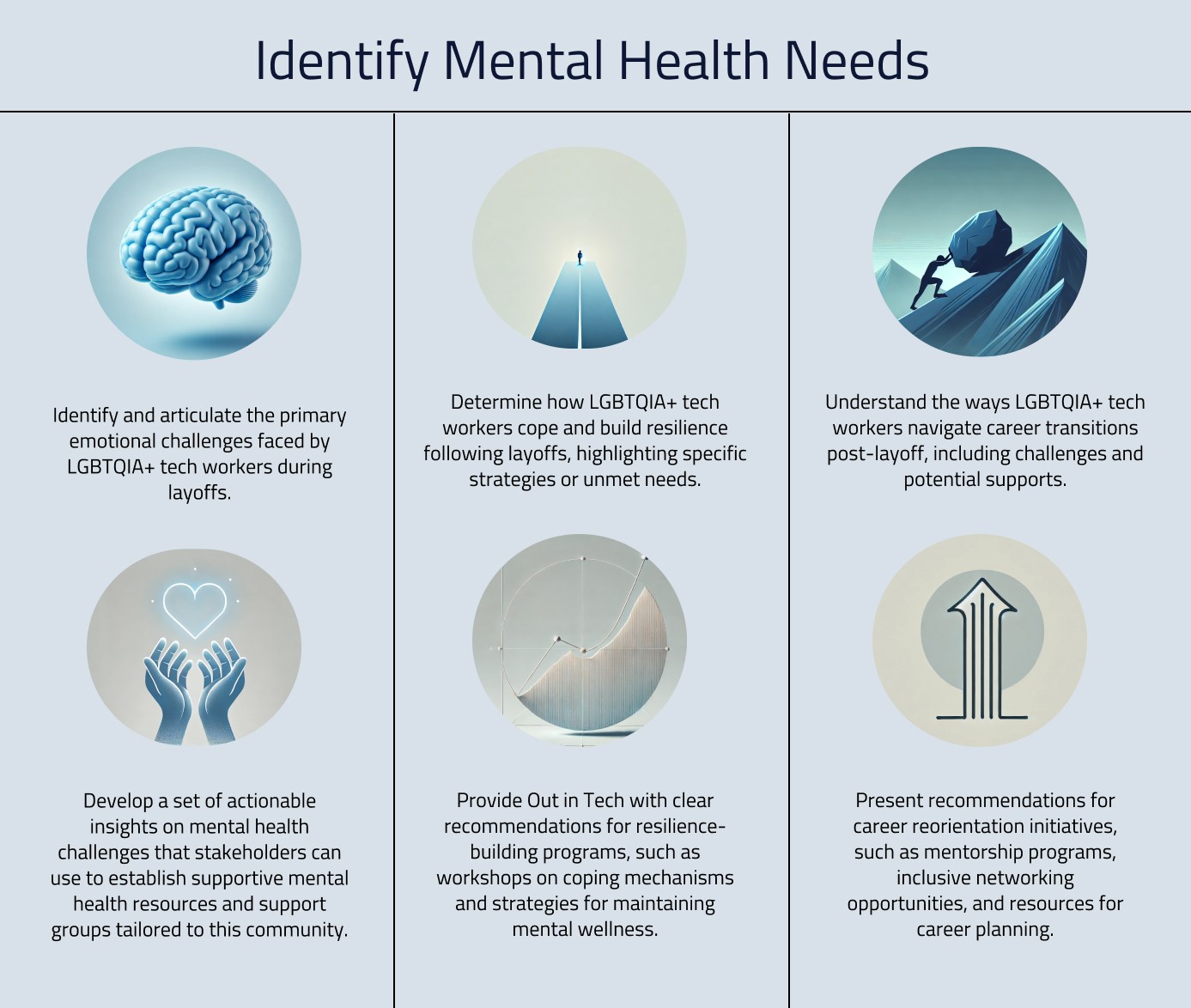
Research Methods
Research Methods
The study uses a qualitative methodology to understand the efforts of these individuals.
Participants
Participants
Participants
The study involved 30-minute in-depth interviews with LGBTQIA+ tech workers who self-identified as queer and had experienced layoffs during the specified timeframe. Participants were recruited using a screener form (Appendix A) to ensure alignment with the study's goals and participant diversity.
Data Collection
Data Collection
Data Collection
In-depth interviews (IDIs) were conducted virtually via Zoom. All participants provided informed consent (Appendix B) and were guided by a structured discussion guide (Appendix C). After the interviews, participants were provided with resources (Appendix D) to support their mental well-being.
In-depth interviews (IDIs) were conducted virtually via Zoom. All participants provided informed consent (Appendix B) and were guided by a structured discussion guide (Appendix C). After the interviews, participants were provided with resources (Appendix D) to support their mental well-being.
Data Analysis
Data Analysis
Data Analysis
Qualitative coding was used to analyze the interview transcripts (Appendix E). Codes were developed to capture emotional experiences, coping strategies and resilience, and career reorientation actions.
Qualitative coding was used to analyze the interview transcripts (Appendix E). Codes were developed to capture emotional experiences, coping strategies and resilience, and career reorientation actions.
Emotional Experiences
Emotional Experiences
Emotional Experiences
Focused on identifying direct statements related to mental health and emotional articulation.
Coping Strategies
Coping Strategies
Coping Strategies
Analyzed participants' strategies for dealing with emotional challenges and building resilience. This included evidence of emotional processing, positive self-talk, concrete actions, and the connection between LGBTQIA+ identity and resilience strategies.
Thematic Development
Thematic Development
Affinity mapping in Miro was used to translate individual coded pieces of transcript into themes. Iterative comparison of codes within each grouping allowed for the definition of themes related to each research question.
Recruitment Criteria & Process
Recruitment Criteria & Process
How did their individual experiences with job loss in the tech industry shape our understanding of this phenomenon?
We aimed to understand the various experiences of individuals facing job loss in the tech industry. Participants' diverse perspectives were essential to our research, revealing the challenges they encountered and the strategies they used. We prioritized creating a comfortable environment for sharing, as their honesty was crucial for grasping the human impact of job loss in this sector.
Who We're Looking For:
LGBTQIA+ Identity: We are looking for individuals who identify as part of the LGBTQIA+ community.
Tech Industry Experience: Participants must have worked in the tech industry within the past two years.
Layoff Experience: We are primarily interested in individuals who have been laid off from a tech job since January 2023. We will also consider those laid off before January 2023, but they will not be prioritized.
Age: Participants must be 18 years old or older by June 1st, 2024.
How We'll Find Them:
Initial Screening: We'll use a simple online form to collect basic information and confirm eligibility. This includes name, email, identity, tech experience, current employment status, layoff experience, and age. The form also includes questions about sexual orientation, race/ethnicity, and other demographic information.
Eligibility Review: The research team will review submitted forms and contact those who meet the criteria.
Informed Consent: Eligible participants will receive an email explaining the study's purpose and procedures. They will also have the option to opt-in to a raffle for a $10 Visa gift card.
Interview Scheduling: Participants who consent will schedule a one-on-one video interview online.
Key Findings
Key Findings
The diverse demographics of participants, spanning various ethnic, racial, gender identity, and sexual orientation spectrums, provide a nuanced understanding of the varied experiences within the LGBTQIA+ community.
Emotional Impact
Emotional Impact
For our first research question, we wanted to understand how queer individuals articulate their emotional experiences. After being laid off, LGBTQ+ individuals describe their emotional state as encircling feelings of depression, being overwhelmed, experiencing heartbreak, feeling devastated, and a general sense of unhappiness.
One of the research participants stated: "When I knew that I was kind of on the chopping block, I had a good cry."
It encompasses a profound sense of mourning for their professional identity, which is often deeply intertwined with their sense of self and worth. This loss can be particularly acute for individuals who find belonging and validation in their workplace community.
One of the research participants stated: "When I knew that I was kind of on the chopping block, I had a good cry."
It encompasses a profound sense of mourning for their professional identity, which is often deeply intertwined with their sense of self and worth. This loss can be particularly acute for individuals who find belonging and validation in their workplace community.
Networking
A common theme we found was that networking is a signal that laid off workers are ready to start the next phase of their journey. Networking is defined as actions taken to establish and nurture professional and personal connections to offer support, create opportunities, and access resources.
One participant shared, "I signed up for some in-person classes here… but also to try to network my way within the tech community here as well." This practice of networking serves as a means of mutual support during a period of job displacement. Participants find it valuable to engage with other people who are navigating a layoff, or those who hold positions in the tech industry, while reorienting their career paths.
Self Beyond Work
Self Beyond Work
This concept, "defining the self beyond work," emerged from our interviews and refers to the resilience developed by separating one's self-worth from one's career and cultivating aspects of one's identity outside one's professional role. Engaging in enjoyable activities to maintain mental well-being during the job search.
This concept, "defining the self beyond work," emerged from our interviews and refers to the resilience developed by separating one's self-worth from one's career and cultivating aspects of one's identity outside one's professional role. Engaging in enjoyable activities to maintain mental well-being during the job search.
Participant #5 expressed this sentiment: "I realized my identity is bigger than my job. I have other, more important parts of myself."
This theme resonated strongly throughout our interviews, appearing six times, making it the second most prevalent theme for this research question. Examples of this theme in action include LGBTQ+ individuals prioritizing their health and well-being after layoffs, recognizing their worth goes beyond their job title, and seeking work that aligns with their personal values and passions.
Next steps &
recommendations
Next steps &
recommendations
By taking these steps, OIT and other queer-serving organizations can create a more supportive and empowering environment for LGBTQIA+ tech workers facing layoffs, helping them navigate this challenging time with greater resilience and ultimately thrive in their careers. Our findings suggest that organizations like Out In Tech (OIT) have a crucial role to play in providing targeted support:
Addressing Emotional Challenges
Addressing Emotional Challenges
Layoffs often trigger feelings of fear, anxiety, and uncertainty, particularly for those who already experience marginalization. OIT can offer programs that address these common negative emotions, providing concrete information and support for navigating the immediate aftermath of a layoff
Fostering Identity Exploration
Fostering Identity Exploration
Resilience during layoffs often involves redefining one's identity beyond their job. OIT can create spaces for LGBTQIA+ individuals to explore and affirm their identity outside of their professional roles, fostering a sense of belonging and self-worth that extends beyond their careers.
Strengthening Queer-Specific Networks
Strengthening Queer-Specific Networks
Connecting with others within the LGBTQIA+ community is vital for support and resources. OIT can promote and enhance queer-specific networking opportunities within the tech industry, providing access to unique job opportunities and career advice tailored to the community's needs.
Prioritizing Mental Health
Prioritizing Mental Health
Maintaining mental well-being is essential during job transitions. OIT can promote mental health awareness and resources, encouraging individuals to engage in grounding activities and self-care to manage stress and maintain a sense of balance.
Maintaining mental well-being is essential during job transitions. OIT can promote mental health awareness and resources, encouraging individuals to engage in grounding activities and self-care to manage stress and maintain a sense of balance.
Link to
Report
Link to Report
Reflections
Reflections
By promoting mental health awareness and fostering inclusive environments, we can help LGBTQIA+ tech workers navigate layoffs and thrive in their careers.
Long-Term Impacts:
Long-Term Impacts:
The study focused on the immediate aftermath of layoffs. Further research is needed to understand the long-term consequences of job loss on the mental health and career trajectories of LGBTQIA+ tech workers.
Beyond the Numbers
Beyond the Numbers
The qualitative analysis goes beyond demographic data, uncovering the lived experiences and emotional struggles of LGBTQIA+ individuals facing layoffs. This humanizes the impact of job loss and provides a deeper understanding of their needs.
The qualitative analysis goes beyond demographic data, uncovering the lived experiences and emotional struggles of LGBTQIA+ individuals facing layoffs. This humanizes the impact of job loss and provides a deeper understanding of their needs.
The Power of Community
The Power of Community
The findings emphasizes the vital role of queer-specific networks in providing support, resources, and a sense of belonging for LGBTQIA+ individuals during challenging times.
•
•
•
•
1
•
•
2
•
•
3
•
•
4
•
•
5
•
•
6
•
•
7
•
•
8
•
•
9
•
•
10
•
•
11
•
•
12
•
•
13
•
•
14
•
•
15
•
•
16
•
•
•
•
•
•
•
•
1
•
•
2
•
•
3
•
•
4
•
•
5
•
•
6
•
•
7
•
•
8
•
•
9
•
•
10
•
•
11
•
•
12
•
•
13
•
•
14
•
•
15
•
•
16
•
•
•
•
•
•
•
•
1
•
•
2
•
•
3
•
•
4
•
•
5
•
•
6
•
•
7
•
•
8
•
•
9
•
•
10
•
•
11
•
•
12
•
•
13
•
•
14
•
•
15
•
•
16
•
•
•
•
•
•
•
•
•
1
•
•
2
•
•
3
•
•
4
•
•
5
•
•
6
•
•
7
•
•
8
•
•
9
•
•
10
•
•
11
•
•
12
•
•
13
•
•
14
•
•
15
•
•
16
•
•
17
•
•
18
•
•
19
•
•
20
•
•
21
•
•
22
•
•
23
•
•
24
•
•
25
•
•
26
•
•
27
•
•
28
•
•
29
•
•
30
•
•
•
•
•
•
•
•
•
•
•
1
•
•
2
•
•
3
•
•
4
•
•
5
•
•
6
•
•
7
•
•
8
•
•
9
•
•
10
•
•
11
•
•
12
•
•
13
•
•
14
•
•
15
•
•
16
•
•
17
•
•
18
•
•
19
•
•
20
•
•
21
•
•
22
•
•
23
•
•
24
•
•
25
•
•
26
•
•
27
•
•
28
•
•
29
•
•
30
•
•
•
•
•
•
•
•
•
•
•
1
•
•
2
•
•
3
•
•
4
•
•
5
•
•
6
•
•
7
•
•
8
•
•
9
•
•
10
•
•
11
•
•
12
•
•
13
•
•
14
•
•
15
•
•
16
•
•
17
•
•
18
•
•
19
•
•
20
•
•
21
•
•
22
•
•
23
•
•
24
•
•
25
•
•
26
•
•
27
•
•
28
•
•
29
•
•
30
•
•
•
•
•
•
•
•