Customer Churn & Retention Analysis
Analyzed customer behavior and service usage data to identify key drivers of churn and provide data-driven strategies to improve customer retention.
Year
2026
Client
Self-Initiated Project
Role
Tools
Python, Pandas, Matplotlib, Seaborn

Overview
What factors drive customer churn and how can retention be improved?
Customer churn analysis reveals patterns across customer tenure, pricing, contract types, and service usage. This project examines these factors to better understand why customers leave and how businesses can improve retention through data-driven strategies.
Problem
Customer churn is a major challenge for subscription-based businesses. Without structured analysis, it is difficult to identify patterns in customer behavior, pricing sensitivity, and contract engagement. This lack of visibility limits data-driven decisions around retention strategies, customer experience, and long-term revenue growth.
Solution
Using Python and data visualization, this project analyzes patterns in customer tenure, monthly charges, and contract types. The results highlight key drivers of churn and provide insights that can support more targeted, data-driven retention strategies.
Context
Understanding Customer Churn in Subscription-Based Services
Streaming and subscription-based services rely heavily on customer retention for long-term growth. As competition increases, understanding why customers leave becomes critical for improving customer experience and revenue stability.
Customer data provides insight into patterns across tenure, pricing, and contract types, revealing key factors that influence churn and long-term engagement.
Exploring Customer Data to Identify Key Churn Patterns
The dataset was explored using Python, focusing on variables such as customer tenure, monthly charges, and contract type.
Initial data cleaning and preprocessing addressed missing values, standardized formats, and prepared the data for analysis, ensuring accuracy and consistency in identifying churn patterns.
Analysis Objectives
Key questions guiding the analysis
What is the overall churn rate?
Which customers are most likely to churn?
How does customer tenure impact retention?
What role do pricing and monthly charges play in churn?
How do contract types influence customer retention?
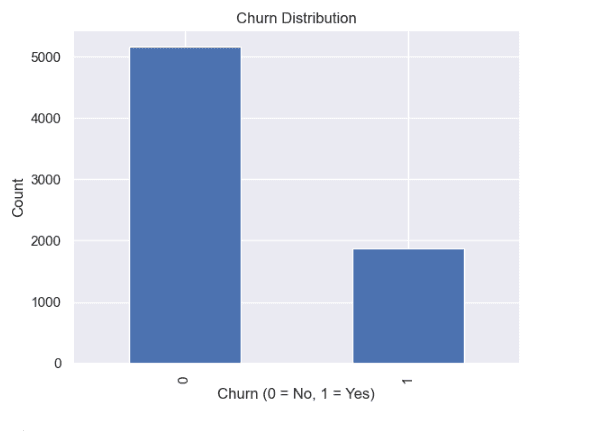
The dataset shows a clear imbalance, with most customers not churning but a significant portion still leaving. This indicates a meaningful churn problem.
While retention is generally strong, a sizable group remains at risk, making churn prediction and prevention a key focus.
Patterns identified from customer churn data
Pricing Impact on Churn
Customers who churn tend to have higher monthly charges compared to those who stay. This suggests that pricing sensitivity plays a role in customer decisions, where users may not perceive enough value relative to cost.
Customer Tenure & Retention
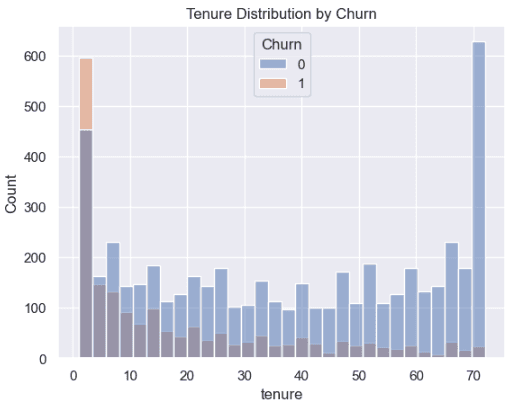
Customers who churn are heavily concentrated in the early stages of their tenure, while long-term customers are significantly more likely to stay. This highlights a critical early churn window where retention efforts are most important.
Contract Type Influence
Customers on month-to-month contracts have the highest churn rates, while those on longer-term agreements show stronger retention. This indicates that long-term commitment reduces churn risk.
Correlation Analysis
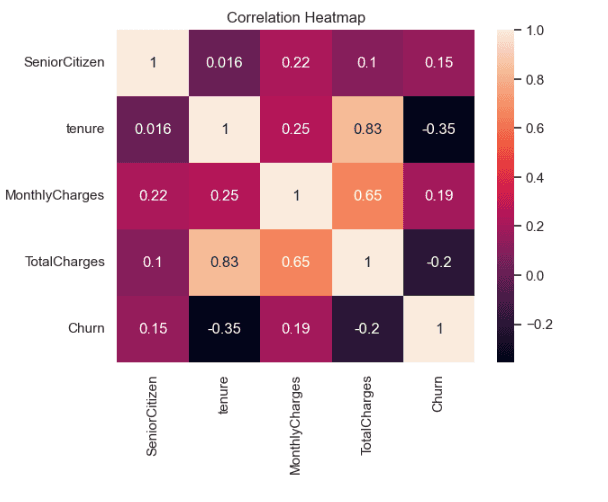
The correlation heatmap highlights relationships between key numerical features and churn. Tenure shows a strong negative correlation with churn, indicating that long-term customers are less likely to leave.
Meanwhile, monthly charges show a slight positive correlation, suggesting pricing may contribute to churn behavior. Overall, tenure emerges as the strongest predictor of churn.
Approach to data cleaning, transformation, and analysis
The analysis was conducted using Python, leveraging libraries such as Pandas and Matplotlib to clean, process, and visualize customer data.
The workflow included data preprocessing, handling missing values, and transforming key variables such as TotalCharges and Churn to ensure consistency and accuracy.
Key steps involved analyzing patterns across customer tenure, monthly charges, and contract types, and creating visualizations to identify key drivers of churn and retention behavior.
Tools & Technologies
Technologies used to conduct the analysis
Python was used for data analysis, with Pandas handling data manipulation and cleaning, and Matplotlib used for visualization.
Jupyter Notebook served as the primary environment for exploratory analysis, enabling an interactive workflow that combines code, outputs, and insights.
Conclusion & Key Takeaways
What the analysis reveals about customer churn and retention
The analysis reveals key patterns in customer churn behavior, including a strong impact of contract type, customer tenure, and pricing on retention outcomes.
Customers on month-to-month contracts and those in the early stages of their lifecycle are significantly more likely to churn, while long-term customers demonstrate stronger retention.
These findings highlight the importance of early engagement, pricing strategy, and long-term commitment in improving customer retention.
Overall, this project demonstrates how data analysis can uncover actionable insights that support more effective, data-driven decision-making in customer retention.